Why Does Paving Turn Green and Black? How to Remove Algae, Moss and Stubborn Black Stains
Have you noticed your driveway gradually turning green, developing dark patches or becoming slippery when wet?
It is a common problem for homeowners throughout South Africa. Brick paving, concrete driveways, pool surrounds, garden pathways and outdoor entertainment areas are constantly exposed to moisture, dust, organic debris and changing weather conditions.
Over time, these conditions can encourage the growth of algae, moss, lichen and other biological contaminants. Surfaces that were once attractive and clean can become discoloured, slippery and increasingly difficult to maintain.
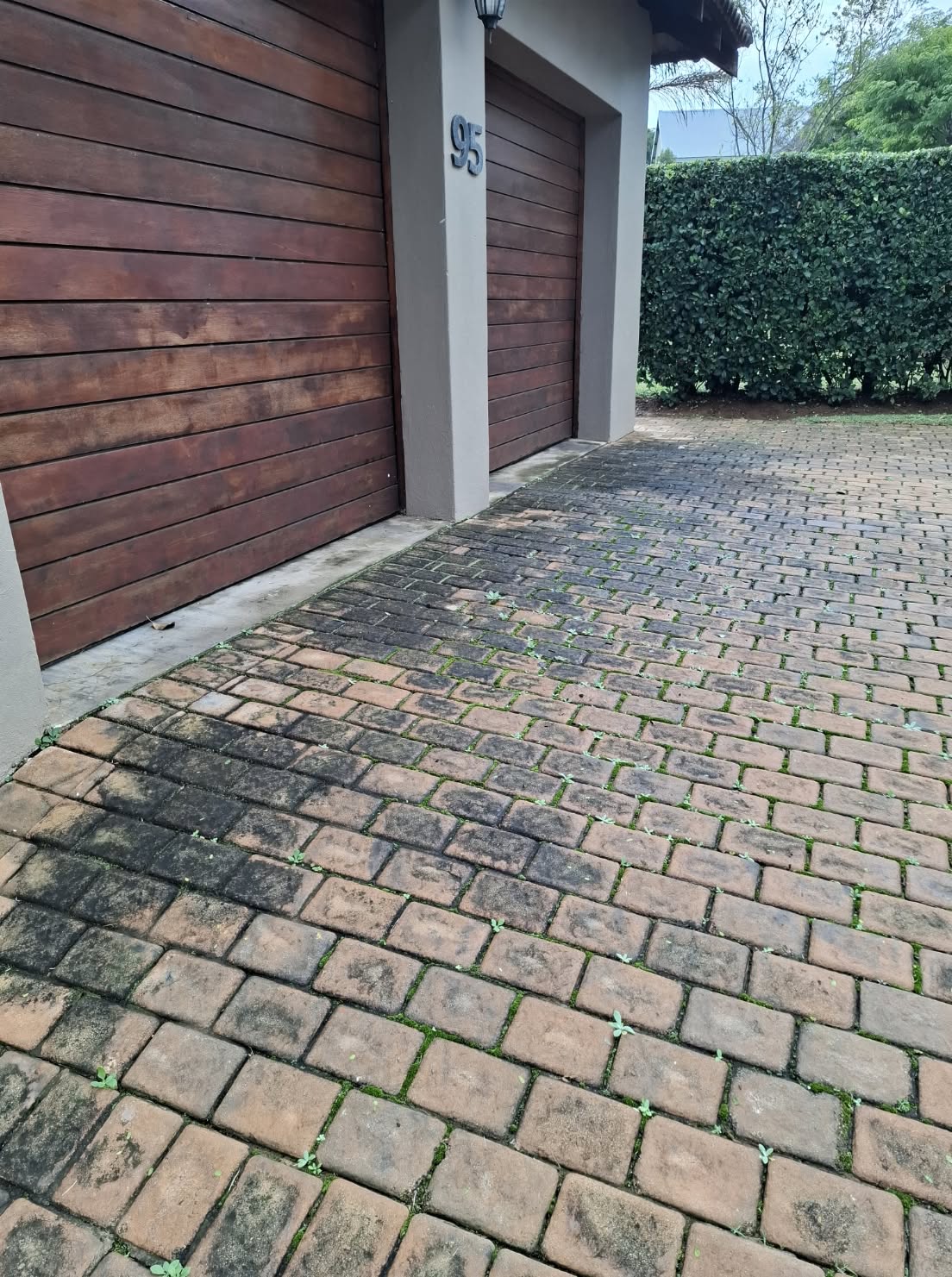
The problem is not always simply dirt. Different types of contamination require different cleaning approaches, and using the wrong method can result in disappointing cleaning results or even damage to the paving.
At 8 Day Exterior Cleaning & Pressure Wash Services, we believe that understanding what is causing the contamination is just as important as choosing the correct cleaning equipment.
In this guide, we explain why paving develops green and black stains, how to identify common types of contamination, which cleaning methods work best and how to keep your outdoor surfaces looking cleaner for longer.
1. Why Does Paving Turn Green?
Green discolouration on paving is commonly associated with algae and other forms of biological growth.
Algae are simple organisms that thrive in environments where moisture and suitable conditions are available.
They commonly develop on outdoor surfaces that remain damp for extended periods, particularly where sunlight and airflow are limited.
You may notice green growth on:
- Brick paving beneath trees.
- Driveways on the shaded side of a property.
- Pool surrounds.
- Garden pathways.
- Areas around leaking taps or irrigation systems.
- Paving with poor drainage.
- Outdoor entertainment areas that receive limited sunlight.
In Gauteng, the seasonal weather contributes to this problem. During summer, thunderstorms and increased humidity can leave paved surfaces damp.
Areas that receive little direct sunlight may remain wet for longer, allowing biological growth to develop.
Dust and organic debris can also accumulate on paving, providing additional material that retains moisture.
The result is often a green film that gradually spreads across the surface.
Is green paving dangerous?
Algae can make paving slippery, particularly when wet.
This is especially concerning around swimming pools, entrances, pathways and areas where people regularly walk.
A driveway that looks relatively harmless when dry may become considerably more slippery after rain.
For this reason, green growth should not be treated as purely a cosmetic problem. Maintaining clean outdoor surfaces can also contribute to safer access around your property.
2. What Causes Black Stains on Paving?
Black staining is slightly more complicated because several different contaminants can produce similar appearances.
Before choosing a cleaning treatment, it is important to establish what is actually causing the discolouration.
Black algae and biological growth
Some biological growth appears dark green, brown or almost black rather than bright green
It commonly develops in shaded, damp locations and may appear as irregular patches or a thin film across the paving.
Certain biological deposits can become firmly attached to the surface, making ordinary rinsing ineffective.
Lichen
Lichen is a combination of organisms that commonly grows on exposed outdoor surfaces.
It can appear as small, firmly attached patches that may be grey, green, yellow or black.
Unlike loose dirt or surface algae, lichen can be particularly stubborn to remove because it attaches firmly to the substrate.
Aggressive scraping or excessive pressure may damage the paving without necessarily removing all the growth.
A suitable treatment and sufficient time may be required.
Mould and mildew
Mould and mildew can develop in persistently damp areas, particularly where organic material accumulates.
They may appear as dark patches, streaks or surface discolouration.
Their presence often indicates an underlying moisture problem that should also be addressed.
General dirt and atmospheric contamination
Black or dark grey paving is not necessarily contaminated by algae.
Accumulated dust, vehicle emissions, soil, decomposing leaves and other environmental contaminants can gradually darken outdoor surfaces.
In areas with regular vehicle traffic, dirt can become compacted into the texture of concrete and brick paving.
Tyre rubber and vehicle deposits
Driveways often develop dark marks where vehicles repeatedly turn, brake or manoeuvre.
These marks can be caused by rubber deposits and other vehicle-related contamination.
They may resemble black algae but require a different cleaning approach.
Oil and grease
Oil stains are another common cause of black or dark brown patches.
These are particularly noticeable on concrete driveways and garage floors.
Oil penetrates porous materials, making older stains difficult to remove with ordinary pressure washing.
Where oil is responsible for the staining, a suitable degreaser or specialist oil treatment may be required.
The important distinction: Not every green or black stain is the same. Identifying the contaminant before cleaning helps determine which treatment is likely to produce the best result.
3. Why Does Algae Grow Faster in Certain Areas?
Have you noticed that one section of your driveway remains relatively clean while another develops green growth every few months?
This is usually related to differences in moisture, sunlight and the surrounding environment.
Shade and limited sunlight
Areas beneath trees, covered patios, boundary walls and buildings often receive less direct sunlight.
Without sufficient sunlight, moisture may take considerably longer to evaporate.
These conditions can encourage algae and other biological growth.
Poor drainage
Paving that retains standing water is more likely to develop biological contamination. Water may collect because of:
- Incorrect paving gradients.
- Blocked drainage channels.
- Low sections in the driveway.
- Poorly positioned downpipes.
- Irrigation overspray.
- Leaking outdoor taps.
Cleaning may remove existing contamination, but if the underlying drainage issue remains, the problem is likely to return.
Trees and vegetation
Trees contribute leaves, pollen, flowers, sap and other organic debris. When this material accumulates on paving, it can retain moisture and contribute to staining.
Jacaranda flowers, leaves and other garden debris can be particularly noticeable during certain times of the year in Gauteng.
Regular sweeping helps prevent organic material from accumulating.
Irrigation systems
Automatic sprinklers can unintentionally keep paving wet. If a sprinkler repeatedly sprays the same section of a driveway or pathway, it can create ideal conditions for biological growth.
Adjusting sprinkler direction may help reduce the problem.
4. How Do You Remove Green Algae from Paving?
The most effective cleaning approach depends on the type of paving, the severity of the contamination and the surrounding environment.
For many outdoor surfaces, the best results come from combining an appropriate cleaning treatment with controlled pressure washing.
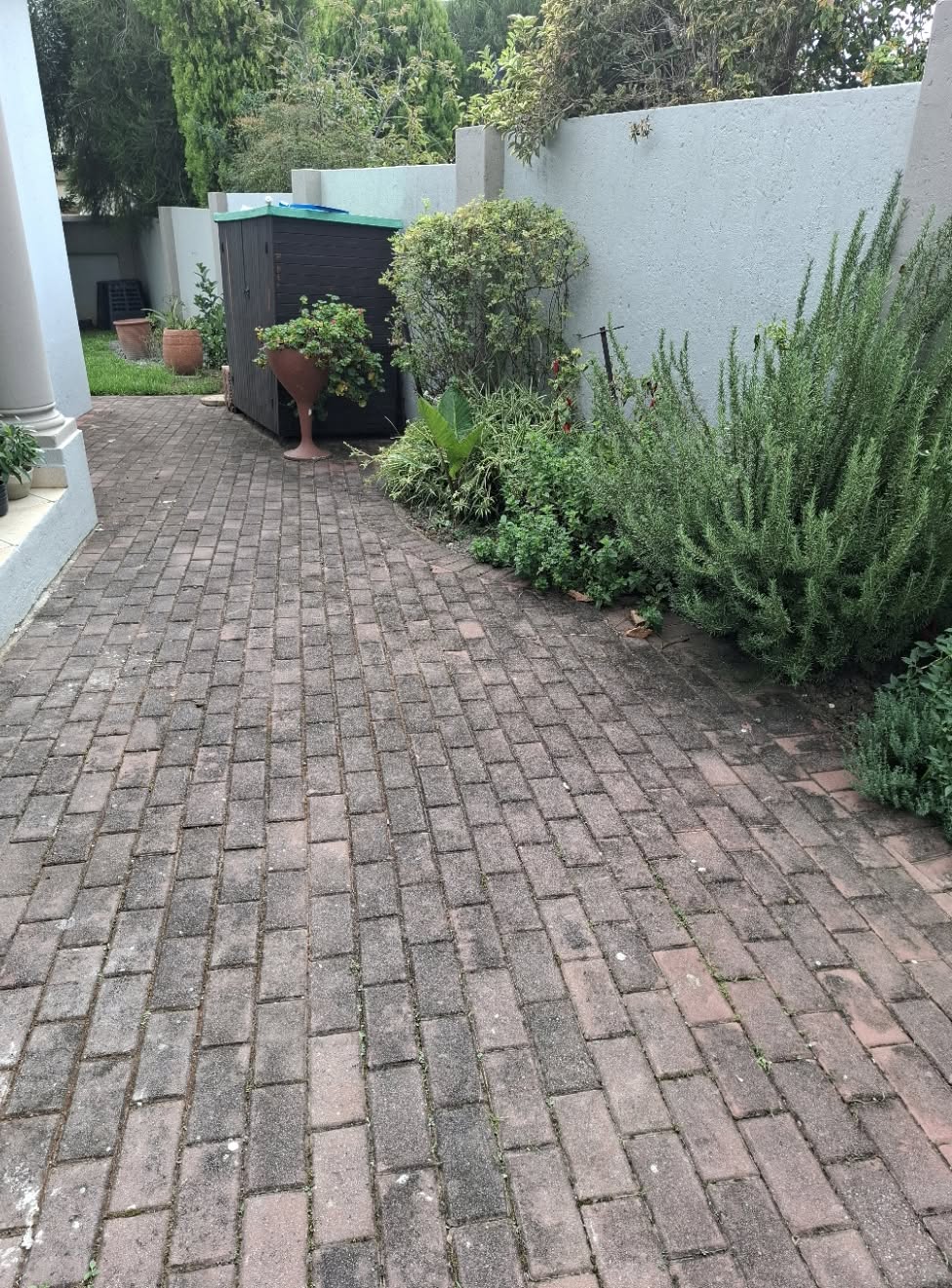
Step 1: Identify the surface and contamination
Before cleaning, establish whether the surface is concrete, interlocking brick paving, natural stone or another material.
Also determine whether the contamination is algae, moss, lichen, general dirt or a combination.
This matters because certain chemicals and cleaning methods may be unsuitable for particular paving materials.
Step 2: Remove loose debris
Sweep away leaves, soil and loose organic material.
This allows the cleaning treatment to contact the contaminated surface more effectively.
Step 3: Apply a suitable cleaning treatment
Depending on the surface and contamination, an appropriate biological cleaning treatment may be applied.
Sodium hypochlorite-based products are used in some professional exterior cleaning applications to treat certain organic growth.
However, they are not suitable for every surface or situation. Concentration, application method, dwell time and thorough rinsing all matter.
Care must be taken around plants, lawns, painted surfaces, metals and sensitive materials.
Never mix sodium hypochlorite with acids, ammonia or other incompatible cleaning chemicals. Dangerous gases or reactions can result.
The manufacturer's instructions should always be followed.
Step 4: Allow appropriate dwell time
Cleaning products need sufficient contact time to work. This is known as dwell time.
Allowing the treatment to work can improve cleaning performance and reduce the amount of mechanical pressure required.
However, the correct dwell time depends on the product, weather conditions and surface.
A cleaning chemical should not be allowed to dry on the paving unless its instructions specifically permit it.
Step 5: Pressure wash the surface
Once the cleaning treatment has worked, controlled pressure washing can remove loosened contamination and accumulated dirt.
A professional rotary surface cleaner is particularly useful for larger paved areas because it provides a more consistent cleaning pattern.
Care should be taken around paving joints and delicate finishes.
Step 6: Rinse and inspect
The area should be thoroughly rinsed where required.
Once the surface has been cleaned, inspect it for remaining biological growth and stubborn staining.
Some areas may need additional targeted treatment.
It is important to understand that heavily established lichen and deep staining may not disappear completely during one cleaning session.
5. Can a Pressure Washer Remove Algae Without Chemicals?
Yes, a pressure washer can physically remove some surface algae and biological contamination.
However, relying entirely on pressure is not always the most effective approach.
There are two important considerations.
First, pressure washing removes contamination mechanically. It does not necessarily treat all biological growth that remains attached to the surface.
Second, increasing pressure to compensate for poor cleaning results can damage the paving.
Excessive pressure can:
- Remove jointing sand from interlocking paving.
- Etch or mark concrete.
- Damage decorative finishes.
- Dislodge exposed aggregate.
- Create uneven cleaning patterns.
For this reason, professional cleaning often combines suitable chemical pre-treatment with controlled pressure washing.
The objective is to achieve effective cleaning without unnecessarily stressing the surface.
6. How Do You Remove Black Spots from Brick Paving?
Black spots are among the more frustrating paving problems homeowners encounter.
They can be particularly noticeable on lighter-coloured concrete pavers.
The difficulty is that black spots can have several different causes.
They may be:
- Lichen.
- Algae or other biological growth.
- Oil contamination.
- Embedded dirt.
- Rubber deposits.
- Organic staining.
The correct treatment depends on identifying the source.
Treating biological black spots
Where the black spots are caused by biological growth, an appropriate biological cleaning treatment may help loosen or remove the contamination.
Some established growth may require repeated treatment.
Treating oil-related black spots
Where oil is responsible, a suitable degreaser or specialist oil-removal treatment is generally more appropriate.
A biological cleaning chemical will not necessarily remove oil deposits.
Treating embedded dirt
Where the contamination is general dirt, a suitable cleaning detergent followed by controlled pressure washing may be sufficient.
Why aggressive pressure washing is not always the answer
Black spots can become firmly attached to the paving.
Attempting to remove them by concentrating a high-pressure water jet directly on each spot can damage the surface.
It is usually better to identify the contamination and select an appropriate treatment.
A small test area is recommended before treating the entire driveway.
7. Why Does Algae Return After Cleaning?
This is one of the most common questions homeowners ask.
You have paid to have your driveway cleaned, it looks excellent, but several months later green growth starts appearing again.
Why?
Because cleaning removes existing contamination, but it does not necessarily eliminate the environmental conditions that allowed the growth to develop.
If the area remains shaded, damp and poorly ventilated, biological growth may return.
The speed of regrowth depends on:
- The amount of sunlight.
- Moisture retention.
- Drainage.
- Surrounding vegetation.
- The type of surface.
- Weather conditions.
- Whether an appropriate post-cleaning treatment was applied.
Can regrowth be prevented?
It is possible to reduce the conditions that encourage biological growth.
Consider the following:
- Improve drainage where water regularly collects.
- Trim vegetation that prevents sunlight and airflow.
- Redirect sprinklers away from paved areas.
- Remove leaves and organic debris regularly.
- Keep gutters and downpipes clear.
- Consider an appropriate protective treatment where suitable.
Some surfaces may also benefit from a suitable post-cleaning biological treatment.
However, no cleaning service or chemical treatment should promise that algae will never return.
The objective is to remove existing contamination and make the conditions less favourable for future growth.
8. Does Sealing Paving Prevent Algae and Black Stains?
Sealing can help protect suitable paving, but it is important to understand what a sealer actually does.
Different paving sealers provide different levels of protection.
Some penetrate into the surface, while others create a surface film.
Depending on the product, a suitable sealer may:
- Reduce water absorption.
- Make certain stains easier to clean.
- Reduce the penetration of oils and other contaminants.
- Improve colour and appearance.
- Help protect against weathering.
Some sealers can also make routine maintenance easier.
However, sealing is not a guaranteed solution to algae growth. If water continues to collect on the surface or surrounding conditions remain favourable for biological growth, contamination can still develop.
Why preparation matters
Paving must be properly cleaned and sufficiently dry before sealing.
Applying a sealer over existing algae, dirt, oil or moisture can compromise the finish.
The correct sealer must also be selected for the specific paving material and intended application.
For homeowners looking for longer-term surface protection, professional paving sealing may be worth considering after cleaning.
At 8 Day, we offer paving sealing and waterproofing solutions designed to help protect suitable outdoor surfaces against environmental exposure and everyday contamination.
9. Can You Use Household Bleach to Clean Green Paving?
Household bleach is sometimes used by homeowners to tackle green discolouration.
Although bleach-based products can be effective against certain biological contaminants, they should not be treated as universal paving cleaners.
There are several considerations.
Surface compatibility:
Some paving materials, coatings and decorative finishes may be sensitive to particular chemicals.
Dilution:
Incorrect concentrations can cause damage or discolouration.
Surrounding vegetation:
Chemical runoff and overspray can damage lawns, plants and garden beds.
Metal fittings:
Certain metals can be affected by inappropriate chemical exposure.
Safety:
Bleach must never be mixed with acids, ammonia or other incompatible products.
Environmental considerations:
Cleaning runoff must be managed responsibly and should not simply be discharged into stormwater systems. For larger areas or heavily contaminated paving, professional assessment is often the safer option.
10. How Often Should You Have Your Paving Professionally Cleaned?
There is no fixed cleaning schedule that suits every property.
A driveway in full sunlight with good drainage may remain clean considerably longer than a shaded driveway beneath large trees.
As a general guide:
- Residential driveways: Consider professional cleaning every 12–24 months, depending on conditions.
- Shaded pathways: Inspect more frequently for biological growth.
- Pool surrounds: Maintain regularly because of moisture and slip risks.
- Outdoor entertainment areas: Clean when accumulated dirt and organic contamination become noticeable.
- Commercial paved areas: Cleaning frequency will depend on foot traffic, vehicle movement and the type of contamination.
These are indicative maintenance intervals rather than strict recommendations.
Regular sweeping and addressing moisture problems can help reduce the frequency of professional cleaning.
11. When Should You Call a Professional Paving Cleaning Company?
Small amounts of surface dirt can often be dealt with using ordinary household cleaning equipment.
However, professional assistance is worth considering when:
- Large areas of paving have become green or black.
- The surface has become slippery.
- Biological growth is firmly established.
- Black spots remain after ordinary cleaning.
- Oil or grease stains are present.
- Previous cleaning attempts have produced uneven results.
- You are concerned about damaging decorative paving.
- You want to clean and subsequently seal the surface.
A professional cleaning company should assess the paving before starting and explain which methods are suitable.
They should also be honest about stains that may not be completely removable.
At 8 Day Exterior Cleaning & Pressure Wash Services, we understand that different surfaces and contaminants require different cleaning approaches.
Our residential, commercial and industrial exterior cleaning services include professional pressure washing, paving cleaning and surface protection.
We operate in Centurion, Pretoria and surrounding Gauteng areas.
Our approach focuses on appropriate cleaning products, suitable equipment and controlled cleaning methods to achieve the best possible result for each surface.
Frequently Asked Questions
1. How do I remove green algae from brick paving?
Green algae can often be removed using an appropriate biological cleaning treatment followed by controlled pressure washing. The correct treatment depends on the paving material and the severity of the growth.
2. Why does my paving turn black?
Black discolouration can result from algae, lichen, mould, embedded dirt, tyre rubber or oil contamination.
Identifying the cause is important because different contaminants require different cleaning treatments.
3. What is the best chemical for removing algae from paving?
There is no single chemical suitable for every paving surface.
Appropriate biological cleaning products, including certain sodium hypochlorite-based treatments, may be effective depending on the surface and contamination. Always follow product instructions.
4. Will pressure washing remove black spots from paving?
It may remove some black spots, particularly where they are caused by surface dirt or loose biological contamination.
Established lichen, oil and deeply embedded stains may require specialist treatment.
5. Why does green algae keep returning to my driveway?
Algae returns when environmental conditions remain favourable. Shade, moisture, poor drainage and surrounding vegetation can all contribute to regrowth.
6. Is green algae on paving dangerous?
It can create slippery conditions, particularly when wet. This is especially important around swimming pools, entrances and frequently used pathways.
7. Can I remove algae without a pressure washer?
Small areas may be treated using a suitable cleaning product and manual brushing. Larger or heavily contaminated surfaces generally benefit from professional cleaning equipment.
8. Does sealing paving prevent algae?
A suitable sealer may reduce water absorption and make maintenance easier, but it cannot guarantee that algae will not return. Moisture and environmental conditions still play an important role.
9. How long does professional paving cleaning take?
The time required depends on the area, surface type, contamination and whether additional treatments are necessary. A straightforward residential driveway may take a few hours, while larger or heavily contaminated areas may take longer.
10. Can professional cleaning restore old paving?
Professional cleaning can significantly improve the appearance of many older paved surfaces by removing accumulated dirt and biological growth. However, it cannot repair structural damage, worn finishes or permanent discolouration.
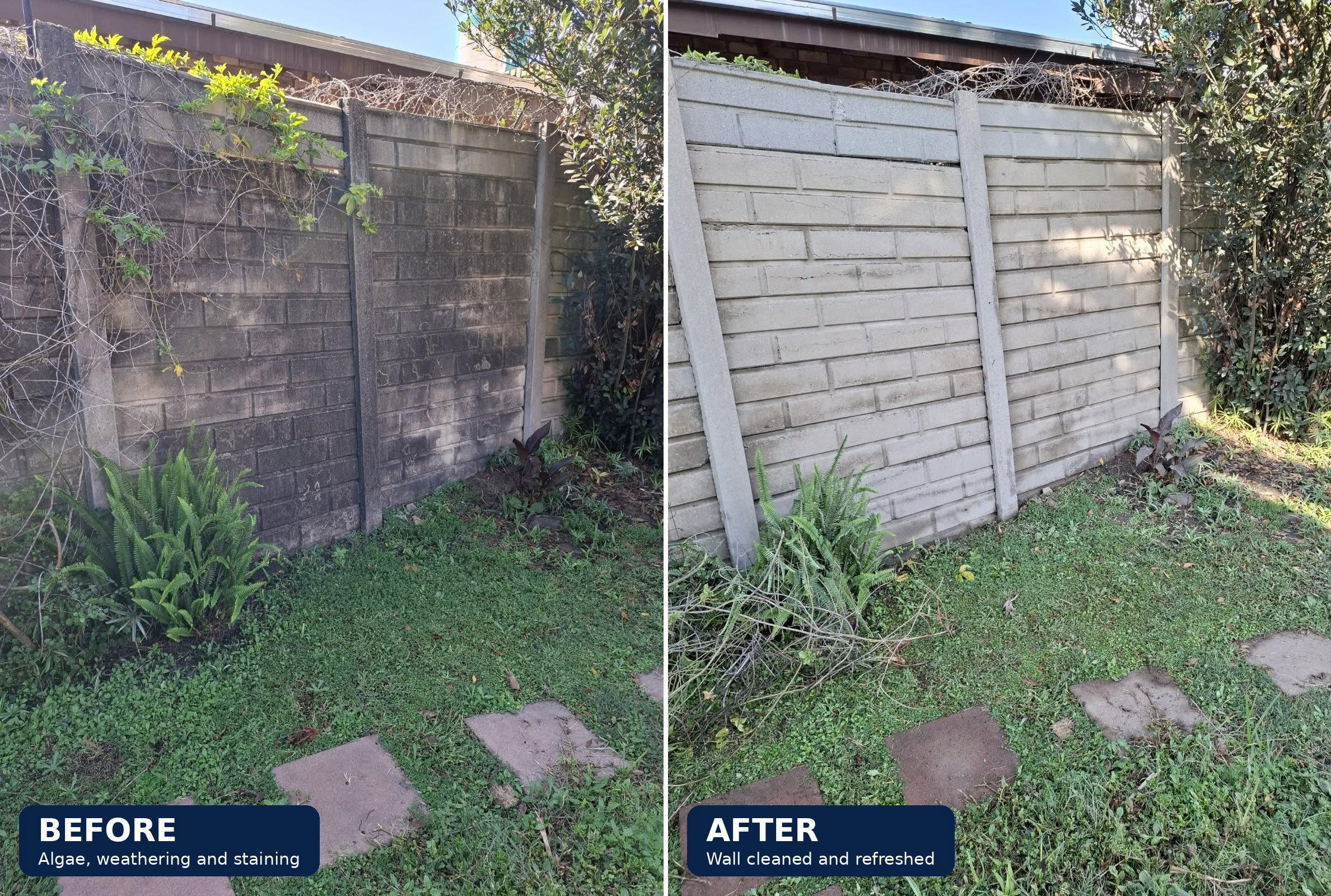
Restore the Appearance of Your Paving with 8 Day
Green algae, black stains and accumulated dirt can make an otherwise attractive property look neglected.
Fortunately, many of these problems can be treated using the correct cleaning products, equipment and techniques.
Whether your driveway has developed green algae, your pool surround has become slippery, or your brick paving is covered in stubborn black stains, choosing the correct cleaning method makes all the difference.
8 Day Exterior Cleaning & Pressure Wash Services provides professional driveway cleaning, paving cleaning, pressure washing and sealing and protection services in Centurion, Pretoria and surrounding Gauteng areas.
Contact us to discuss your cleaning requirements and arrange a quotation.
Website: www.8day.co.za
Telephone / WhatsApp: 060 335 8422
Email: tim@8day.co.za